Remember when you used to Google something and all you’d see were links to websites? Those days probably seem like ancient history. Now, more than ever, Google is giving the answer directly to you.
Type “how to fix a leaky faucet,” and Google writes you a five-step guide.
Type “why is my car not starting,” and Google lists nearly a dozen possibilities.
Ask “are the Iowa Hawkeyes or Cyclones better,” and it breaks down their head-to-head record (while very wisely sidestepping a direct answer).
That little AI summary at the top of your search results page is called an “AI overview” (AIO), and it’s profoundly changing how we interact with Google. It’s also changing the game for businesses who want to be found online.
If you rely on Google searches to bring people to your business’s website, you may wonder, “Is AI good or bad?” “Is it hurting my website traffic?” or “How can I make sure I’m showing up where it counts?”
If you’re asking these questions, you’re asking the right ones! Webspec’s digital marketing and search engine optimization (SEO) experts work daily to help businesses become more visible online as Google search continues to change. Here’s a quick guide to help you understand how AI is changing search, what it means for your business, and how you can stand out in the crowded online world.
AI & Google Search: A Quick History
There are a ton of AI companies out there, so why are we specifically writing about Google? It’s because online search is a David vs. Goliath game, and Google is still the champ. Google’s market share for online searches is about 90%. That’s a commanding lead over other search engines, one that continues even as people increasingly use AI chatbots like ChatGPT, Perplexity, and Grok to find information.
Google released AI overviews nationwide in May of 2024. It was a response to Microsoft’s search engine, Bing, which had partnered with ChatGPT to include AI summaries next to search results several months earlier. Google is continuing to tweak how the overviews work, but today, they show up on top of many queries. Some estimates say it’s between a quarter and one-third of all searches.
While these AI overviews are relatively new, the use of AI in Google search isn’t. Google has been using AI to create search results since at least 2015, when it launched RankBrain, an AI system that helped it connect words with broader concepts.
The continuous evolution of AI has allowed Google to move away from simple keyword-matching (although relevant keywords are still important!) to the point where it understands related concepts, topics, and meaning in a larger sense. That’s why old-school SEO tactics like “keyword stuffing” — repeating certain words over and over in your content to rank higher — don’t work as well anymore.
How Do Google’s AI Overviews Work?
Google’s AI overviews currently run on a version of Gemini, Google’s large language AI model. When the overviews appear, they typically show at the top of the search engine results page.
AI overviews include a written summary that incorporates links to websites it uses as sources. It also includes a sidebar of larger website links to the right of the overview.
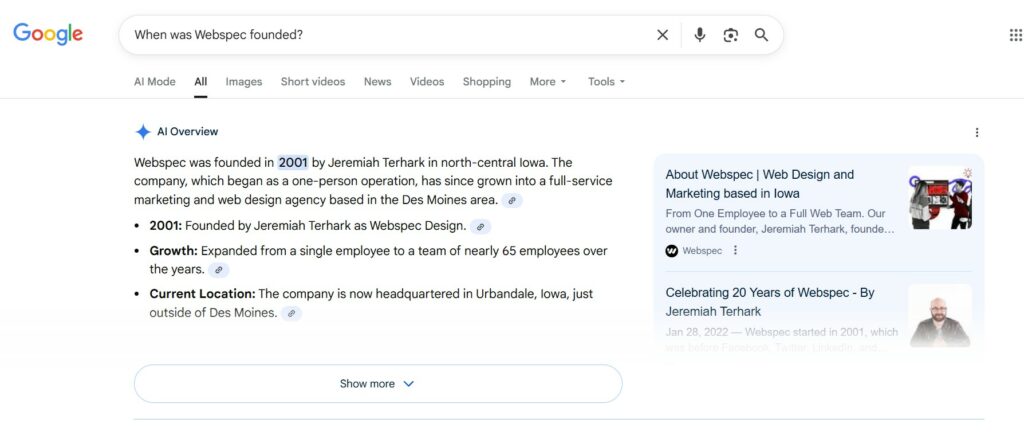
Even if a website is used as a source in an AI overview, users are far less likely to click on a citation than if it were a normal search result. The reason is pretty obvious: Google is already synthesizing the information for the user right on the page, so there’s no need to click unless the user needs to go deeper.
These overviews also often push everything else in the search results down, giving the top-ranking website search result less visibility to the users who are just there for a quick answer.
Google has said these AI overviews are driving “higher quality clicks” to websites, but this is highly disputed by the digital marketing community, and the impact on the number of clicks is still evident. This is particularly true for keywords where people are looking purely for information (a search like “what are the best running shoes”), as opposed to looking to buy a product (“buy running shoes online”) or visit a specific business (“Nike store Des Moines”).
How Do AI Overviews Affect SEO?
One of the biggest impacts of AI overviews is how businesses may be showing up in more search results but receiving fewer clicks.
Two common measurements we use to see how well a business website is performing include:
- Impressions: The number of times someone searched for something and Google showed your website on a search results page.
- Clicks: The number of times someone actually clicked on your website after searching on Google.
In the past, when a website was improving its visibility, it was common to see impressions rise, followed closely by clicks. The AI overviews disrupted that thinking – showing in some cases that impressions would rise while clicks would remain the same, or drop. Search engine marketers referred to it as the “great decoupling.” Here at Webspec, we saw lots of websites with changes like this:
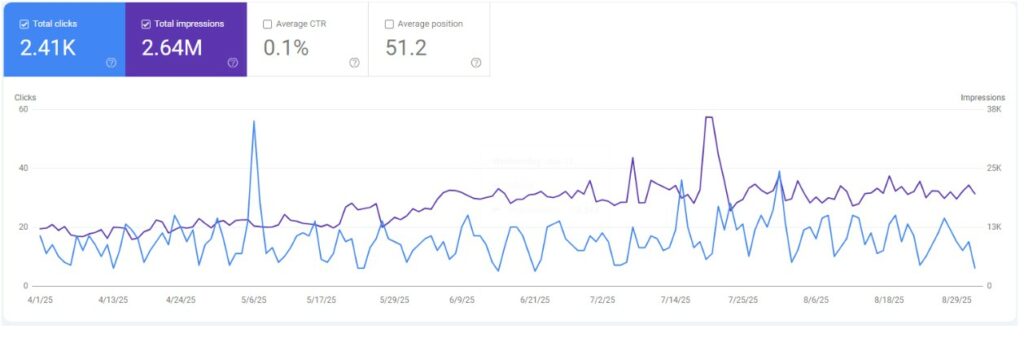
Or this:
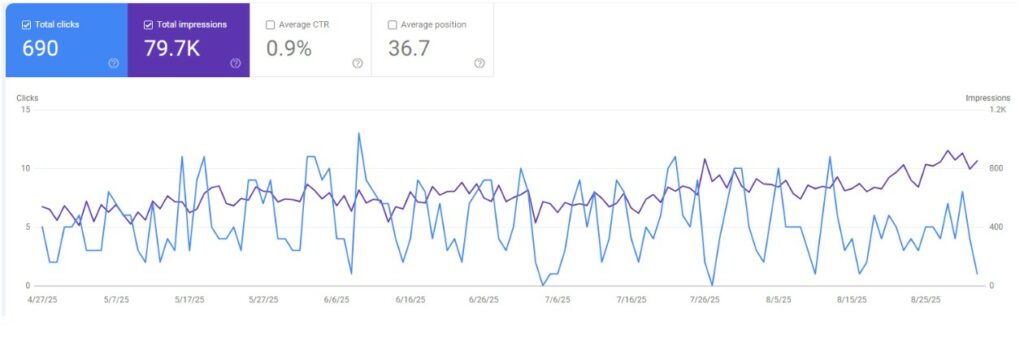
What Can My Business Do to Improve Its Visibility?
OK, we’ve talked about Google’s AI overviews and their impact. Now what should you do about it? Regardless of whether we think AI is good or bad, it’s here to stay, so it’s important to see what you can do to stand out.
Here are a few tips.
1. Take Advantage of All Visibility Opportunities — Especially in Local Search
A word you’ll often hear at Webspec is visibility. That’s because the Google search results page is crowded with features that your business can take advantage of. The goal isn’t just a #1 ranking on Google for a keyword – it’s being as visible to your users as possible in these different areas.
AI overviews are one of many ways Google shows users additional information. Here’s a quick look at some of the other types of results you might see, and how to help your business show up.
The Local Pack (Maps)
If it’s a business search, like “donuts near me,” there could be a map with information on the closest donut shops and how to get there.
Take Action: Optimize your Google Business Profile and website to ensure you’re showing up in these relevant searches by including as much context for your products and services as possible, not just on your website, but across the web.
Paid Ads
If it’s a keyword lots of users search in order to buy something, you’ll see sponsored ads at the top of the page, where businesses have paid to be there.
Take Action: Identify relevant keywords that your target audience is searching for and run ads to gain visibility. Ads are going to be introduced to AI Overviews soon, so using paid advertising to stay at the top of search results is key.
Featured Products
If it’s a shopping search term, you might see small snippets of products that link to ecommerce websites.
Take Action: Ensure your product pages have the correct schema markup to show up in this prime location.
2. Build Your Visibility in AI Results
Users may not be clicking all the time, but AI overviews are a prominent part of the Google search results page. When you’re cited as a source in them, it means Google sees you as an authoritative source on your topic. This builds trust in your brand, and it’s worth shooting for.
The good news is that principles for ranking your content in both traditional search results and in AI results are very similar.
One of the ways to do this is to build a reputation of being an authoritative source in your industry. When anyone can tell AI to consolidate the treasure trove of information on the web and write a 1,000-word blog post for them, it’s going to take more than just repackaging existing knowledge. You can do this by infusing your business’s unique, human insights into your content, or by publishing original information or research.
You can also structure your content so it’s easy for AI models like Gemini and ChatGPT to pull from. This also doesn’t require anything new. Subdividing your content using headings, writing with conversational language, breaking lists into bullet points, and more, is just good web writing.
3. Continue Shooting for #1
That said, don’t let all of your focus go to appearing in AI. The first few results under the AI overview are still gold for your business. Finding the Google searches that your most high-value users are searching will help your website be right there when it matters most.
This could include writing high-quality blog posts for topics that aren’t covered as well in the industry, or optimizing your service pages to appear for local searches for your products (like “shoe stores in Des Moines”).
Using a combination of these three strategies will help you stay relevant, no matter what Google does next with AI.
Ready to Strategize Your Website’s SEO in the Age of AI?
If all of the change in AI and SEO seems overwhelming, don’t worry. Webspec is here to help you through the noise. Our digital marketing team helps small businesses in Iowa and across the United States optimize for search every day, helping them get the results they need to keep them relevant.
Check out our online portfolio to explore how we’ve helped many Iowa businesses boost their online visibility. Want to see what we can do for your business? Contact us to learn more.